



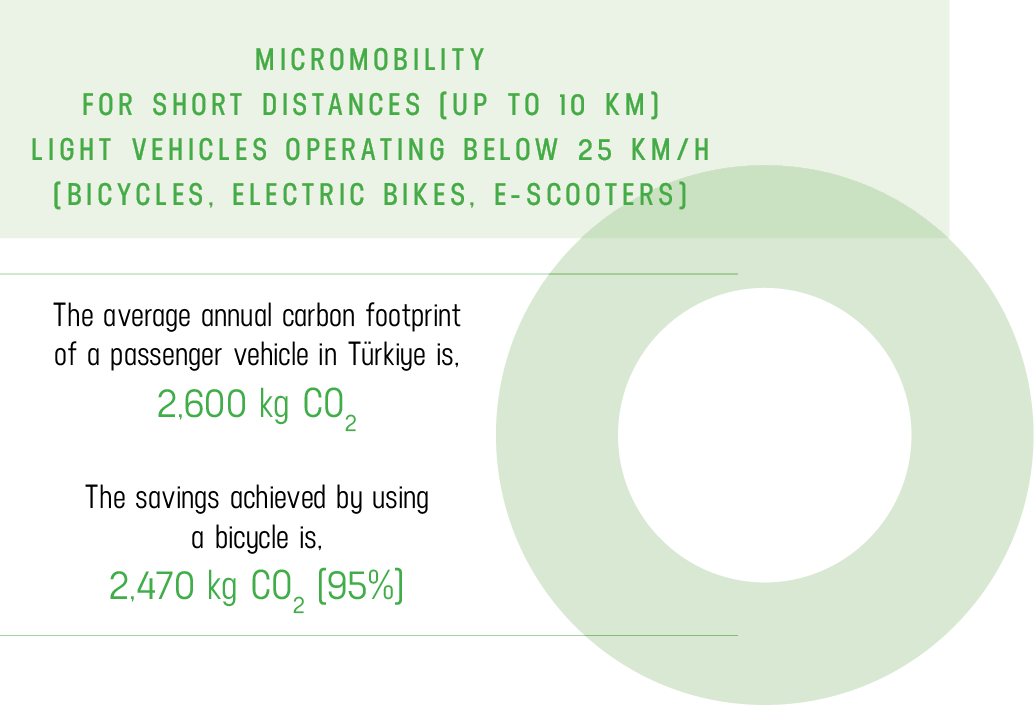
- Opting for micromobility options instead of vehicles can significantly reduce the carbon footprint. Micromobility options include walking, cycling, electric bikes, and shared scooters. For short distances (trips of up to 10 km), light vehicles such as bicycles, electric bikes, and e-scooters, which operate at speeds below 25 km/h, can be used.
- In Türkiye, the average annual carbon footprint of a passenger vehicle is approximately 2,600 kg of CO2 (assuming it drives 15,000 km per year and consumes an average of 7 liters of fuel per 100 km). However, the carbon footprint of cycling is at least 95% lower. This means that by using a bicycle instead of a car, you can save an average of 2,475 kg of CO2 per year. By choosing micromobility options for your short-distance trips, you can reduce your carbon footprint.
URBAN PUBLIC TRANSPORTATION
- For urban transportation, you can prefer public transportation (such as buses, metrobuses, subways, trams, ferries, etc.) instead of using your personal vehicle, both in terms of time and cost. Opting for public transportation whenever possible is always a choice that reduces carbon emissions compared to using a personal car. Additionally, choosing public transport alternatives will help reduce traffic congestion.
- Public transportation vehicles with dedicated routes, such as metro and metrobuses, provide approximately 40% time savings compared to using your personal vehicle.
- Private vehicle transportation leads to significantly higher carbon emissions compared to public transportation (according to IETT data, approximately 7-7.5 times more).
- Vehicles used for sea transport run on fossil fuels, which contribute to the carbon footprint. However, since they operate as public transport, they cause less environmental damage compared to personal vehicle use. For example, for a person living in Istanbul, choosing the ferry instead of a car for the Üsküdar - Beşiktaş route is an option that reduces carbon footprint and saves time.
- To prevent traffic congestion, you can reduce the use of personal vehicles. A vehicle stuck in traffic contributes 2.5 times more carbon emissions compared to normal traffic conditions.
URBAN BICYCLES / ELECTRIC BICYCLES
- In areas where cycling is feasible, you can use a bicycle or electric bicycle for short-distance trips instead of fossil fuel-powered vehicles.
- You can encourage more people around you to use bicycles or electric bicycles.
- The carbon reduction capacity of electric bicycles is the maximum cumulative carbon dioxide emission reduction potential that can be achieved if people replace short car trips with electric bicycles as much as possible.
INTERCITY TRANSPORTATION
Bus
- For intercity travel, choosing a bus instead of your personal vehicle will reduce your carbon footprint. Considering the distance between two cities and the number of passengers on the bus, the per-person carbon footprint will be lower.
Train / High-Speed Train
- Although railways account for 8.5% of transportation activities, they contribute only 0.6% of greenhouse gas emissions. If emissions from electricity generation are taken into account, this rate rises to 1.5%. Therefore, if possible, you can prefer train travel for transportation.
Airplane
- Air travel accounts for 11.6% of all transportation emissions, with 81% of this coming from passenger flights. Therefore, whenever possible, you can choose transportation options with a lower carbon footprint as an alternative to air travel.
- According to the International Air Transport Association (IATA), aviation contributes approximately 2% of global carbon emissions. Therefore, for essential air travel, you can opt for airlines that prioritize environmentally friendly practices.
 Previous